

Herb in Thai notifiable formulas
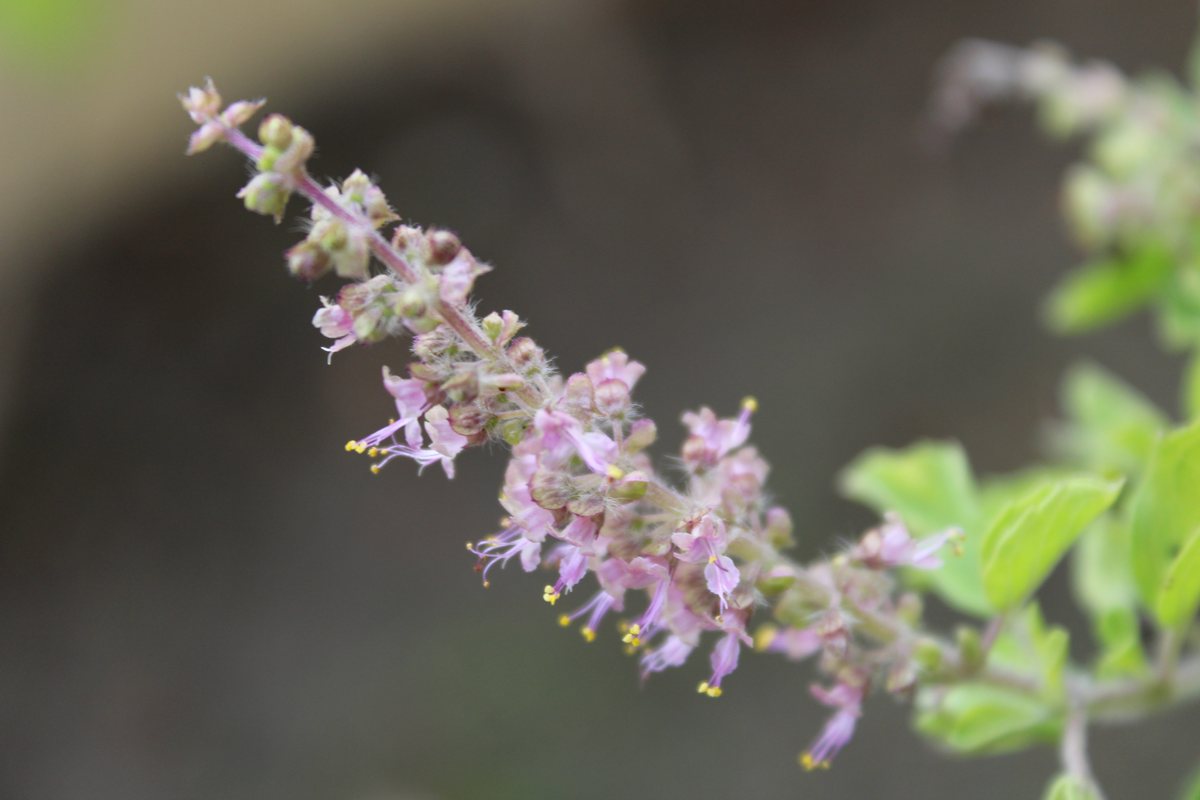
Holy Basil Leaf
กะเพราแดง · Kaphrao Daeng
Ocimum tenuiflorum L.
- Family
- Labiatae
- Part used
- leaf
- Crude drug
- Ocimi Tenuiflori Folium
- In the announcement
- Used in 5 notifiable formulas (1 as capsules)
Thai Herbal Pharmacopoeia (THP)
Constituents and quality criteria of Holy Basil Leaf
Summarised from the Holy Basil Leaf monograph of the Thai Herbal Pharmacopoeia, Department of Medical Sciences, the standard used to test the dried leaf of the red variety.
The pharmacopoeia sets no minimum marker content for this herb. Use the raw material quality criteria below for acceptance testing.
Constituents
Holy Basil Leaf contains up to about 1.7 per cent of volatile oil, of which methyl eugenol, caryophyllene and methyl chavicol are its major components. It also contains β -carotene, sterols, fatty acids, etc.
Raw material quality criteria
| Acid-insoluble ash | Not more than 2.0% w/w |
| Sulfated ash | Not more than 20.0% w/w |
| Water-soluble extractive | Not less than 20.0% w/w |
| Ethanol-soluble extractive | Not less than 5.0% w/w |
| Volatile oil | Not less than 1.0% v/w |
Storage: Holy Basil Leaf shall be kept in well-closed containers, preferably of metal or glass, protected from light and stored in a cool and dry place.
Source: Thai Herbal Pharmacopoeia, Department of Medical Sciences (online edition, accessed 21 October 2026)Read the full THP monograph
Formulas using Holy Basil Leaf
5 formulas containing Holy Basil Leaf
Select a formula to see its ingredients and indications. Formula names and indications are a reference translation; the Thai announcement is the legal text.
- Ya Prasa Kaphrao Holy basil formula for bloating and colicRelieves abdominal bloating, flatulence and abdominal colic/flatulent discomfort
- Kaphrao Holy basilHelps reduce symptoms caused by indigestion
- Ya Prasa Kaphrao Holy basil formula for bloating and colicRelieves abdominal bloating, flatulence and abdominal colic/flatulent discomfort
- Ya Prasa Kaphrao Holy basil formula for bloating and colicRelieves abdominal bloating, flatulence and abdominal colic/flatulent discomfort
- Ya Kae Ai Mai Mi Samha Formula 2 Formula for dry cough, Formula 2Relieves cough, throat irritation and dry voice
Development potential
Develop Holy Basil Leaf into a product with the TIBD group
In notifiable formulas5 formulas1 as a single-herb formula
THP raw-material criteria5 testsfor acceptance testing before production
Marker with a minimum contentNot setquality is checked with the raw-material criteria
Testing in the groupVISBIOVolatile compound analysis by GC-MS
Three ways forward 1Notify a listed formula2Adapt it through detailed notification3Develop a Category B herbal medicine or Category C health productSee the development pathway
VISBIO · laboratory in the TIBD group
Volatile compound analysis by GC-MS
Analytical testing of Holy Basil Leaf raw materials and products by VISBIO, the laboratory in our group.
See the VISBIO serviceK-API · manufacturing in the groupExtract and manufacture at K-API
The TIBD group plant licensed by the Thai FDA to manufacture herbal products, so extraction and production stay within the group.
See the K-API plantTIBD · consultationPlan a product with Holy Basil Leaf
We check whether your formula qualifies for notification, detailed notification or registration with the Thai FDA, then prepare the filing documents.
Talk to our team on LINE